
· 6 min read · Last reviewed
How the Wordabulary Placement Assessment Works
By the Wordabulary Team
When you sign up for Wordabulary, one of the first things you do is a short quiz called the placement assessment. Its job is modest but important. It gives the app a rough idea of where you are, so your first practice sessions are neither far too easy nor frustratingly hard. This guide explains how it works and what to make of the result.
Why there is an assessment at all
Vocabulary learning only works when the words are at the right level. If you are shown words you already know, you waste time. If every word is far beyond you, you learn little and lose heart. Starting everyone at the same point would mean one or the other for most people.
So a new learner takes the assessment before using practice or quizzes. The result sets your starting level, and your level then adjusts as you practice. It is a first guess that the app keeps improving.
What the questions look like
The assessment is a short run of twelve multiple-choice questions. Each shows you one English word and four possible definitions. You choose the one you think is correct. As soon as you pick, the answer lights up as correct or incorrect, and you move on to the next question.
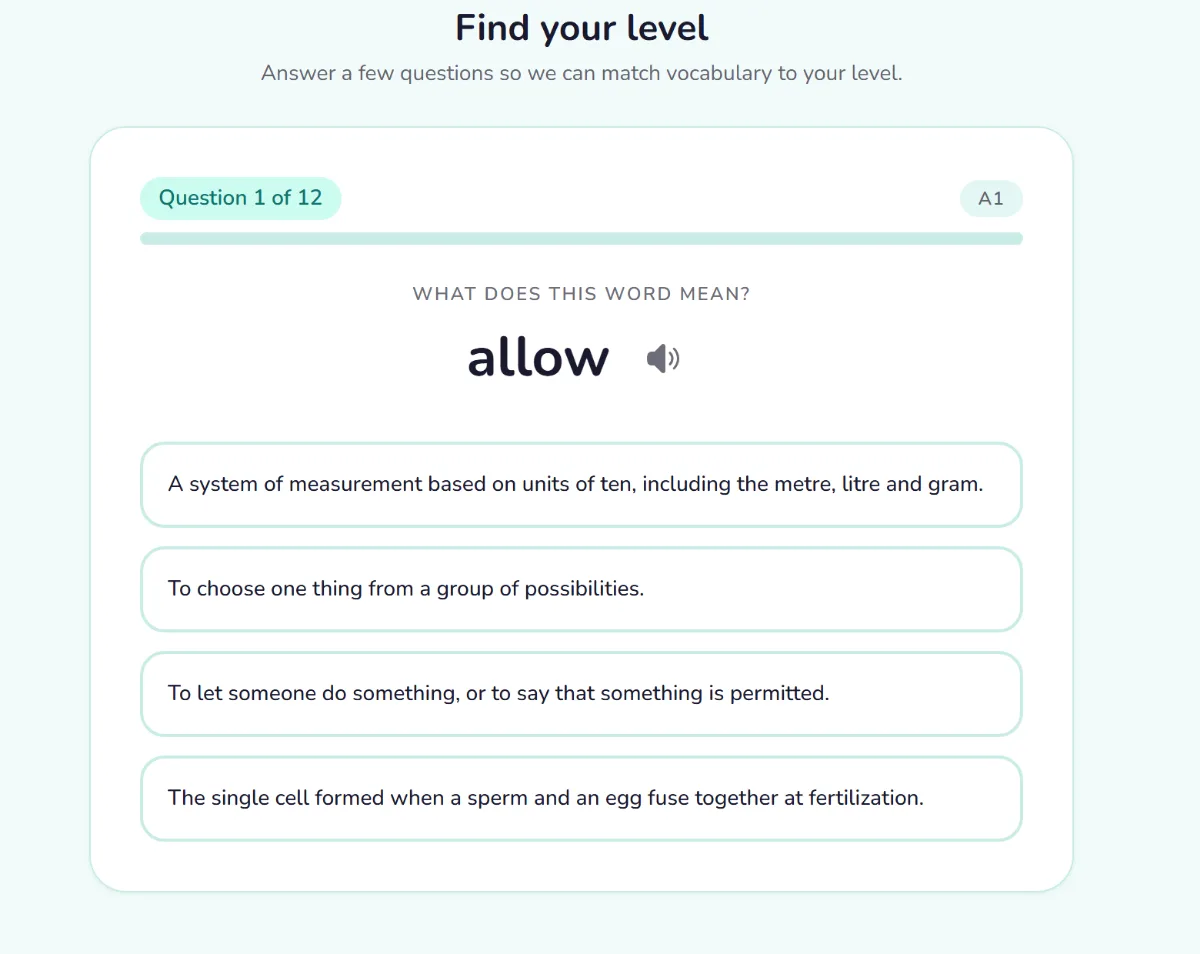
One question: a word, a button to hear it, and four meanings. The small label shows the word's CEFR level.
The words come from across the CEFR scale, the six-level framework used to describe language ability, from A1 at the start to C2 at the top. If the scale is new to you, what CEFR is explains it from the beginning. The questions are spread through those levels, with two words from each, so the early ones feel easy and the later ones get harder. Each word has a button to hear it spoken, in case the sound helps you recall the meaning.
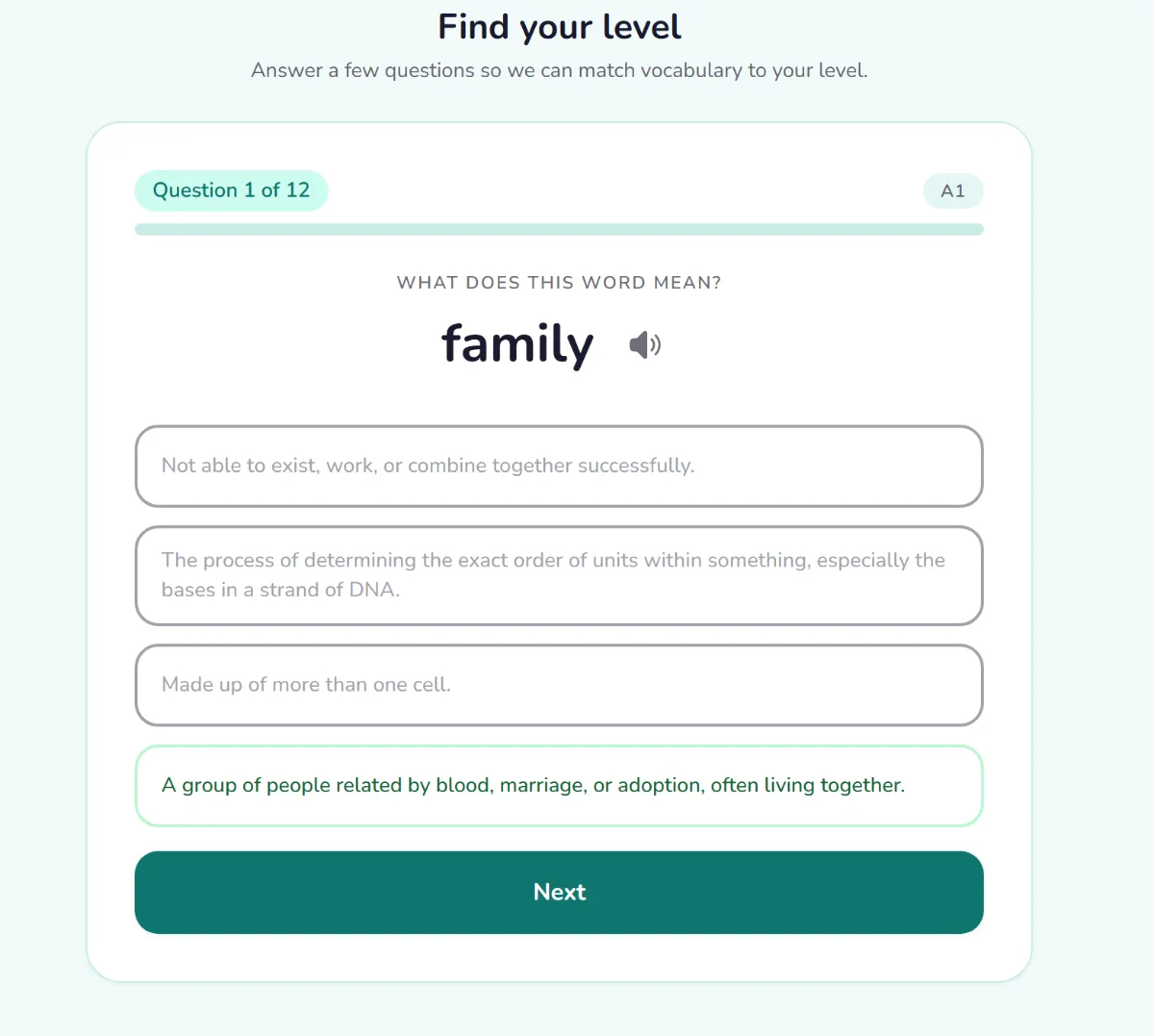
Right after you pick, the correct meaning is marked and the Next button appears.
The assessment is short, so it does not take long to finish.
How your level is decided
Your result is worked out from where you got questions right.
For each level, the assessment asks about two words. If you answer at least one of the two correctly, you are counted as having shown knowledge at that level. Your result is the highest level where that happened, and it is shown as one of six labels, from A1 (Beginner) to C2 (Mastery).
That has a few consequences worth knowing.
It looks at the top of what you know, not an average. You do not need to get everything below your level right. A few slips at the easy end will not drag your result down if you show knowledge higher up.
A lucky guess can raise the result. With four options on each question, a blind guess is right one time in four. Because only one correct answer per level is needed, a guess that lands can push you up a level. This is one reason the result is a starting point, not a verdict.
It cannot see everything. Twelve questions is a very small sample of an English vocabulary of thousands of words. It tests recognition of meaning, and it does not test how well you can use a word in speech or writing.
What the result is, and what it is not
The result is an estimate that sets your starting level in Wordabulary. It is not a certificate, an exam score or a prediction of how you would do in a language test. Different tests measure different things, and the real exams for English also test reading, writing, listening and speaking.
If you want to understand how a level relates to the size of vocabulary, vocabulary size by CEFR level gives rough figures and explains why they are only rough.
Tips for taking it
Answer honestly. Try to choose what you actually think the word means. Choosing a definition you recognize from a different word can give a wrong result. If your result is too high, you may find practice too hard. If it is too low, practice will feel too easy, though your level will adjust.
If you truly do not know, make your best guess. There is no penalty for a wrong answer. But do not click at random on the early questions, because the quiz is only useful if the early ones reflect what you know.
Do not look words up. The assessment is more useful as a snapshot of what you know now.
Use a quiet moment. It is short, but a calm few minutes give a better picture than a rushed attempt.
After the assessment
Once you have a result, you can go straight to your dashboard or to the page you were trying to reach. Practice and quizzes now draw words around your level. As you practice, your level moves up or down depending on how you do, so a result that is a little off at the start will correct itself over time. For a look at what a practice session involves, see how a Wordabulary practice session works.
Retaking the assessment
You can take it again whenever you feel your level has changed. The dashboard has a "Reassess my level" card with a Retake assessment button, and the same link is in the menu once you have finished your first one. People often retake it after a few months of regular practice, or after a long break from English.

The Reassess my level card on the dashboard has the Retake assessment button.
Free accounts have a limit on how many retakes they can do in any 30 days, and the app tells you when you have reached it. Pro accounts can retake it as often as they like.
A retake is worth doing if:
- you feel that practice has become too easy or too hard,
- you have been learning English elsewhere and think you have moved up, or
- your first result seemed off, perhaps because you rushed it.
If none of those apply, you can leave it. Your level already adapts as you practice.